
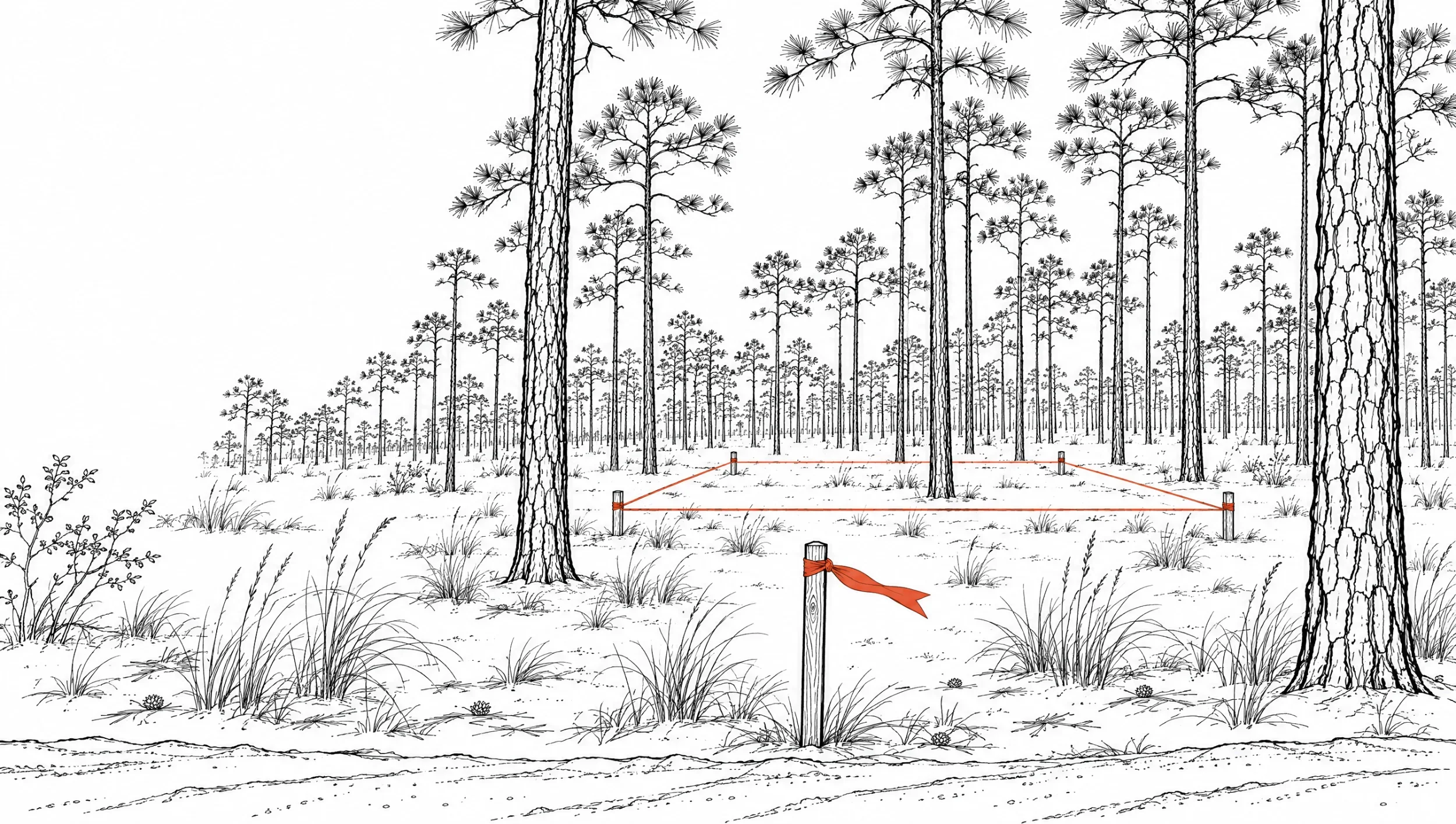
Illustration: a survey stake and a staked-out house footprint among longleaf pines.
A lot is not buildable because the listing says it is. It is buildable when the county or town, the soil, the water, the road and the recorded documents all agree. The time to find out which of them disagrees is before closing, while you can still renegotiate or walk away.
North Carolina purchase contracts usually give a buyer a negotiated due diligence period for this kind of investigation. The Real Estate Commission describes it as the buyer's opportunity to investigate the property and the transaction, with the right to terminate for any reason or no reason while the period is open. After it closes, your earnest money is typically at risk. So the practical question is not whether to check a lot. It is what to check first, because some of the answers take weeks.
Here is the order we would check them in.
1. Find out who regulates the parcel
A Pinehurst or Southern Pines mailing address does not tell you which planning office reviews the lot. A parcel may fall under a town's planning jurisdiction or under Moore County's, and each has its own setbacks, height limits and permit process.
Start with the county's GIS maps, which include zoning, flood zone and watershed maps. Then confirm the zoning district and its standards with the planning office itself. Our custom home guide lists the planning contacts for Aberdeen, Pinehurst and Southern Pines.
2. Sewer or septic decides more than you would expect
If the lot is not served by public sewer, state law requires an improvement permit and a construction authorization from the local health department before construction starts. In Moore County that office is Environmental Health, which takes septic and well permit applications.
The permit is not a formality. It records where the system goes and how much wastewater it is designed to handle. That is how a septic permit ends up shaping the bedroom count, the house footprint, the driveway route and whether a pool is ever possible. NC State Extension's guide for land buyers, Investigate Before You Invest, says to ask those questions before you buy, to leave room for a repair area, and to keep wells, including a neighbor's, at least 100 feet from the system.
Three things are worth knowing:
An existing permit belongs to a site and a house. Under the statute, a change of ownership does not affect a permit as long as the site and the facility it serves stay the same. A different bedroom count or footprint means going back to the county.
Some permits expire. A permit issued with a plat is valid without expiration. A permit issued with a site plan is valid for five years. Ask which kind the seller has, and when it was issued.
A soil map is a screening tool. Extension notes that suitable and unsuitable soils can sit side by side on the same lot. The Sandhills have a reputation for sand that drains. A reputation is not a permit.
3. Water, power and the cost of getting them to the house
Ask each utility for availability in writing, including where the nearest line is and who pays to extend it. If there is no public water, a private well needs its own permit from Environmental Health, and its location has to work with the septic layout. A lot can have room for a house, a septic field and a well, and still not have room for all three in the right relationship.
4. Flood zones, streams and watershed rules
Look the address up in the North Carolina Flood Risk Information System. If part of the lot is in a Special Flood Hazard Area under county jurisdiction, Moore County's flood ordinance requires a floodplain development permit before any development. It also requires a new home's reference level, basement included, to sit at least two feet above base flood elevation, and it requires elevation certificates. Towns administer their own flood rules, so confirm with the office from step 1.
Parts of the county also sit in water supply watershed overlay districts. In the county's jurisdiction, those rules set density limits, for example an average of one home per two acres in the most protected areas. They also require a vegetated buffer of at least 30 feet along perennial waters, where new building is not allowed. Lots lawfully created before January 4, 1994 are treated differently, which is one more reason to learn the parcel's history.
Low, wet ground deserves its own look. Extension lists swampy areas and designated wetlands among the first things to rule out when you walk a lot. If you see standing water or wetland plants, get a professional opinion before you design around them.
5. The driveway is a permit too
Access is easy to assume and expensive to fix. If the lot fronts a state-maintained road, connecting to it runs through an NCDOT driveway permit, handled by the local District Engineer's office. Where the driveway is allowed to enter then decides where the garage can face.
If the lot does not touch a public road at all, ask the closing attorney to confirm a recorded right of access. "Everyone has always driven across there" is a history, not an easement.
6. Read the recorded restrictions before you fall for a house plan
Many Moore County neighborhoods have recorded covenants and a design review process. They can set minimum house sizes, exterior materials, tree removal rules and construction deadlines. Ask for the recorded covenants and the current design guidelines, and read them before you pay for drawings.
In Pinehurst, also check whether the lot is inside the Village's Local Historic District. New construction, alterations and demolitions there need a Certificate of Appropriateness, and the Historic Preservation Commission reviews major work.
7. Look up, at the pines
Moore County is one of the Sandhills counties covered by the U.S. Fish and Wildlife Service's red-cockaded woodpecker Safe Harbor program. The Service reclassified the bird from endangered to threatened in October 2024, and federal protections still apply. Its guidance for pine land is to have a qualified professional survey the property for woodpeckers. Do that before anyone prices the clearing.
What to have in hand before the due diligence period ends
A current survey showing boundaries, easements and anything recorded against the lot
The zoning district and its setbacks, confirmed by the planning office
A septic improvement permit for the bedroom count you intend, or public sewer availability in writing
A path to a well permit, or public water availability in writing
A flood zone lookup, and a watershed check if a stream or pond is nearby
Driveway access confirmed by NCDOT or the town
The recorded covenants, the design guidelines and the review process
One sketch that shows the house, driveway, septic field, repair area and well together
That last item is the test. If they do not all fit on paper, they will not fit on the lot.
Illustration: the fit test. House, driveway, septic field, repair area and well have to work on the same lot. Not a real parcel, not to scale.
Size the due diligence period to the slowest item on the list, and get any extension in writing, as the Commission advises. Your agent and closing attorney can tell you how your contract handles it.
Where we fit
We look at a lot from two directions. Our designers test whether the house you want fits the buildable area. Our construction team looks at the site work the listing does not mention.
If you are comparing lots in Aberdeen, Pinehurst, Southern Pines or elsewhere in Moore County, send us the parcel address and what you hope to build. Tell us which decision you need to make first, and we will start there.
Related: Planning a custom home in Moore County · Residential design · Construction
This article is general information, not legal, surveying or engineering advice. Rules change and parcels differ, so confirm requirements with the offices linked above. Sources checked November 10, 2026.
Sources
NC Real Estate Commission, "Due Diligence" Questions and Answers
N.C. General Statutes § 130A-336, improvement permit and construction authorization
Moore County Environmental Health, Septic / Wells
NC State Extension, Investigate Before You Invest (AG-439-12)
Moore County Unified Development Ordinance, Chapter 16, Watershed Overlay Districts
Moore County Unified Development Ordinance, Chapter 17, Flood Damage Prevention
Moore County, GIS Maps
NCDOT, Driveway Permit FAQ
Village of Pinehurst, Historic Preservation Commission
U.S. Fish and Wildlife Service, Red-cockaded Woodpecker Safe Harbor Program: North Carolina Sandhills