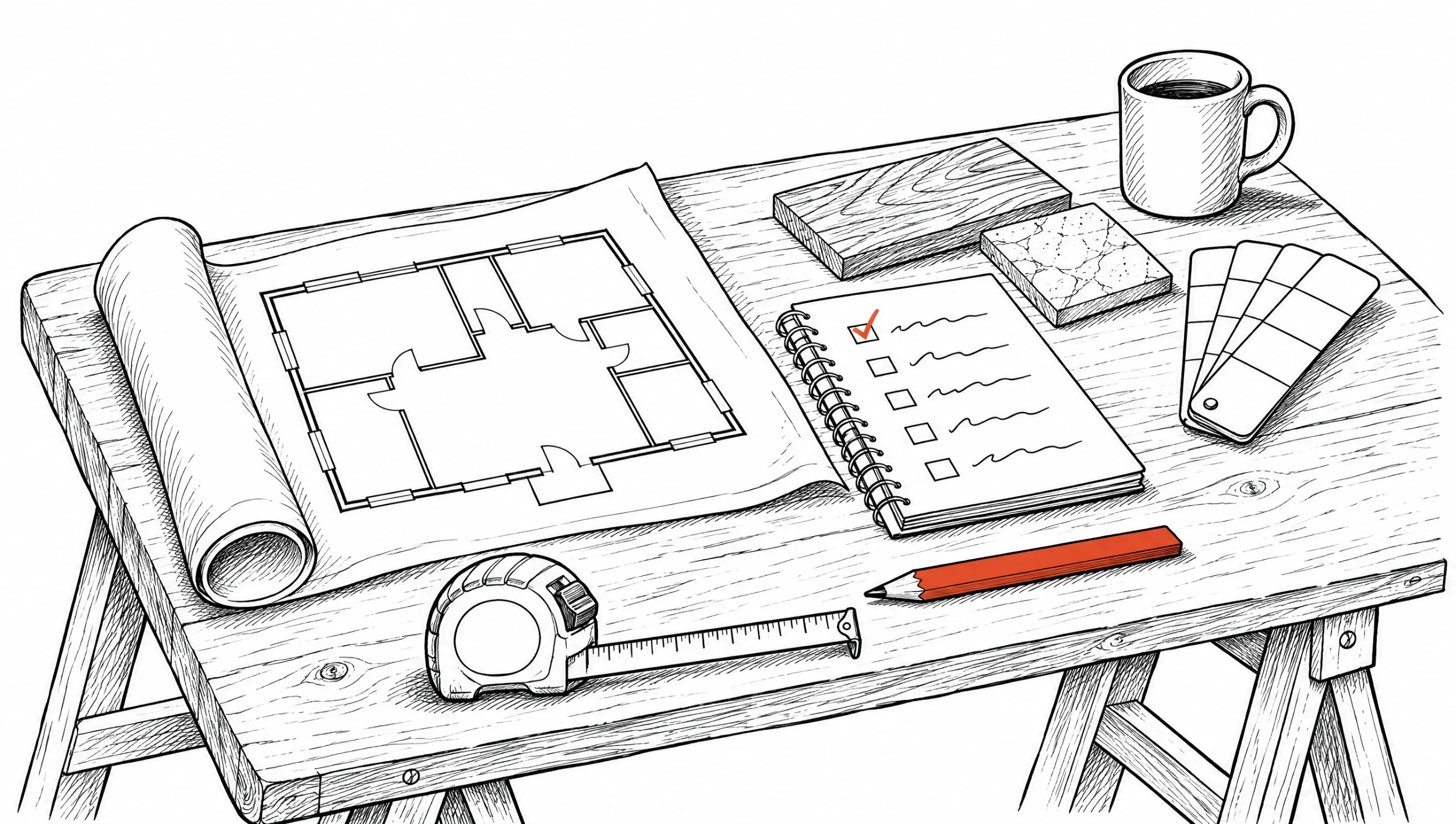
Illustration: a builder's table with drawings, a checklist and material samples.
A builder can only price what has been decided. Everything you have not decided still gets priced, just as somebody else's assumption. That is how two builders can price "the same house" and land far apart, each of them right about the house they pictured.
So the quickest route to a useful number is not asking more builders. It is making a few decisions first. None of them needs finished drawings.
1. Decide which kind of number you need
There are three, and they are not interchangeable.
A rough range. Built from size, building type and location, before any drawings exist. It answers one question: is this worth pursuing?
A budget estimate. Built from preliminary plans and a written outline of materials and finishes. It tells you what to keep, cut or change while changes are still cheap.
A contract price. Built from complete drawings and selections. This is the number you sign.
Ask for a contract price at the sketch stage and you will not get one. You will get a rough range with cents on the end.
Illustration: three kinds of construction numbers. The more that has been decided, the narrower the number.
2. Know where it is going
Give the parcel address, not just the town. The site moves the price more than most people expect: clearing, grading, the length of the driveway, and whether the lot has public sewer or needs a septic system and a well. If you are still choosing land, settle that first. We laid out the order to check it in Before You Buy a Lot in Moore County, Check the Build Constraints.
For an addition or a remodel, the site is the house you already have. Photos, the year it was built and any old plans tell a builder more than a description does. With an older house, expect the price to say how hidden conditions will be handled. Nobody can see inside a wall from the driveway.
3. Describe the building in rooms, not adjectives
You do not need a floor plan to say what the building has to hold. Write down the rough size you have in mind, one story or two, the number of bedrooms and baths, garage bays, porches, and anything unusual, such as a workshop or a home office with its own entrance. For a remodel, list which rooms change, which walls move and whether you plan to live there during the work.
"Open and airy" cannot be priced. "Three bedrooms, two and a half baths, a two-car garage and a screened porch" can.
4. Show the level of finish
The level of finish is one of the biggest things you control in a price, and the words for it are close to useless. Everyone's "mid-range" is different.
So point at things. A house you have been inside. Photos of a kitchen you would be happy to own. The window line or the countertop material you expect. A builder can price a photo. Nobody can price "nice."
Where you have not chosen yet, the price will carry an allowance: a placeholder amount for something to be selected later. Allowances are normal. They are also where a low number can hide, so ask how many there are and what each one assumes.
5. Say the budget out loud
Plenty of owners keep the budget to themselves, on the theory that the price will rise to meet it. It is a sound instinct on a car lot. In design and construction it backfires, because nearly every choice only makes sense against a number. If you do not give yours, the designer or builder has to guess it, and you end up comparing your real budget with their guess.
Give a range, and say what it has to cover. Construction only? Or also the land, design, permits and utility connections, landscaping, furniture and a reserve for surprises? The same figure describes very different houses depending on the answer.
If a lender is involved, ask early what it will need from your builder and when. Lenders keep their own lists, and those lists can shape the schedule.
6. Name your dates, and which ones cannot move
A target start date helps. A date that cannot move helps more: a lease ending, a school year, a baby on the way. Fixed dates change how the work has to be planned, and it is better to price that plan than to discover it later.
Mention any reviews you already know about. If the lot is in a town or neighborhood with design review, that time comes before construction starts. Our custom home guide has a section on who reviews the plans.
7. Decide who decides
Name one person, or two who agree, as the builder's contact for decisions. Every price assumes that answers arrive on time. A project where each choice waits on a group vote tends to run long, and no estimate shows that up front.
8. Check who can legally give you the price
In North Carolina, a contractor who takes on a building project costing $40,000 or more has to hold a general contractor license. Licenses come in three sizes. A limited license covers a single project up to $750,000, an intermediate license up to $1,500,000, and an unlimited license has no cap. The cost of the land is not counted toward those limits.
So before you compare prices, look each builder up on the licensing board's website and confirm that the license is active and large enough for your project. A price from someone who cannot legally sign the contract is not a price. MODUS Design Build holds an unlimited license. Look us up too.
What to ask for in return
When the number comes back, ask for it in writing, with what it includes, what it leaves out and what it assumes. The North Carolina Department of Justice advises homeowners to get at least three written estimates, and a written contract that describes the work, the quality of materials, the total price, and the start and finish dates.
We would add one thing. Give every builder the same information. If each one priced a different description, you did not get three prices for one project. You got one price each for three projects.
Where we fit
We design and build in Moore County, so we can help at either end of this list: working out what the building should be, or reviewing drawings you already have to see what is ready to price.
For a first conversation, send us the town or parcel address, any drawings or photos you have, a budget range and a target start date. If some of that is undecided, say so. "Not sure yet" is a useful answer. It tells us which decision to start with.
Related: Planning a custom home in Moore County · Residential design · Construction
This article is general information, not legal or financial advice. Licensing rules change, so confirm current requirements with the sources below. Sources checked November 11, 2026.
Sources
N.C. General Statutes § 87-1, who must hold a general contractor license
N.C. General Statutes § 87-10, license limits
NC Licensing Board for General Contractors, license search
NC Department of Justice, Home Improvement